
|
|
| NEW ZEALAND / AOTEAROA | |
| region: Waikato | |
map →
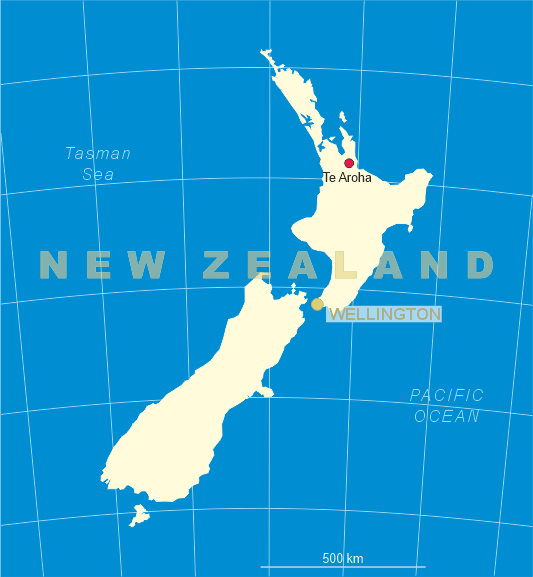
Te Aroha is situated at an elevation of 24 m at the foot of 952 metres (3,123 ft) Mount Te Aroha, the highest point in the Kaimai Range, about 53 km northeast of Hamilton, the seat and most populous city of the Waikato region on the North Island of New Zealand. The municipality has a population of about 4,700 (2025).
The name Te Aroha comes from the eponymous Mount Te Aroha. The name of the mountain is shortened from Te Aroha-a-uta
(love flowing inland). This name is accepted as describing a longing for a homeland, with various stories in Māori oral tradition about
the naming of the mountain. Originally, the northern area of the town was known as Morgantown after the Māori chief Mokena (Morgan) Hou,
whilst the southern part was known as Lipseytown after Hou's daughter Ema and her husband George Lipsey.
The Te Aroha block was first surveyed in 1879. George Lipsey was the first European to settle in Te Aroha.
The population grew quickly during the 1880s as a result of a gold rush. A spa was founded in 1883 but popularity had declined by the 1930s.
 In the 1880s farmers came to settle the surrounding area which helped with the growth of Te Aroha and the wider Piako County area.
A report in 1881 described the town as being in the most favourable spot referencing transport, roads, and farm land surrounding the town.
The railway from Hamilton to Te Aroha was completed in 1886, opening a direct link from Auckland and greatly increasing Te Aroha’s
accessibility and popularity for visitors. However, starting in the 20th century the popularity of the baths at Te Aroha declined.
In the 1880s farmers came to settle the surrounding area which helped with the growth of Te Aroha and the wider Piako County area.
A report in 1881 described the town as being in the most favourable spot referencing transport, roads, and farm land surrounding the town.
The railway from Hamilton to Te Aroha was completed in 1886, opening a direct link from Auckland and greatly increasing Te Aroha’s
accessibility and popularity for visitors. However, starting in the 20th century the popularity of the baths at Te Aroha declined.
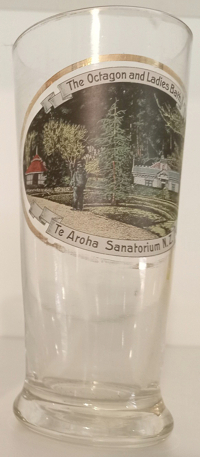
Glass no. 5001 [left] shows a view of the
 Octogon and Ladies Bath of the Te Aroha sanatorium.
The possibility of a 'sanatorium' being developed at Te Aroha was raised as early as the 1870s. Following Te Aroha land purchases in 1878,
the springs area was designated the ‘Te Aroha Hot Springs Reserve’ in 1882 under the Public Domains Act. The construction of the first permanent
bath houses began in 1883. By the 1890s Te Aroha had become the most popular Spa in the country (although Rotorua soon took over following its
connection to the rail network in 1894). By the turn of the century 22 springs had been discovered and by 1910 many new facilities were
established. From their heyday in the early 20th century there ensued a gradual decline. Most facilities had closed or were re-purposed by
the mid-20th century, although basic maintenance of the Domain and retention of its facilities continued. In signs of turning the corner in more
recent years there appear to have been some reconsolidation of experiences in the Domain. ‘Te Aroha Mineral Spas’ was opened in 1980, providing
modern spa pools using the thermal soda water. Overall the focus appears to have now shifted to as much a historic heritage theme as a hot springs
theme. Compared to other thermal water attractions in New Zealand, the living historic heritage component now appears to represent a particularly
unique feature of the Te Aroha Hot Springs attraction.
Octogon and Ladies Bath of the Te Aroha sanatorium.
The possibility of a 'sanatorium' being developed at Te Aroha was raised as early as the 1870s. Following Te Aroha land purchases in 1878,
the springs area was designated the ‘Te Aroha Hot Springs Reserve’ in 1882 under the Public Domains Act. The construction of the first permanent
bath houses began in 1883. By the 1890s Te Aroha had become the most popular Spa in the country (although Rotorua soon took over following its
connection to the rail network in 1894). By the turn of the century 22 springs had been discovered and by 1910 many new facilities were
established. From their heyday in the early 20th century there ensued a gradual decline. Most facilities had closed or were re-purposed by
the mid-20th century, although basic maintenance of the Domain and retention of its facilities continued. In signs of turning the corner in more
recent years there appear to have been some reconsolidation of experiences in the Domain. ‘Te Aroha Mineral Spas’ was opened in 1980, providing
modern spa pools using the thermal soda water. Overall the focus appears to have now shifted to as much a historic heritage theme as a hot springs
theme. Compared to other thermal water attractions in New Zealand, the living historic heritage component now appears to represent a particularly
unique feature of the Te Aroha Hot Springs attraction.
[https://de.wikipedia.org/wiki/Te_Aroha, https://en.wikipedia.org/wiki/Te_Aroha;
https://researchcommons.waikato.ac.nz/entities/publication/9c42261d-48eb-4709-8937-0e5590abe798;
https://www.mpdc.govt.nz/component/content/article/113-news-a-events/projects/3759-te-aroha-spa-history]
![[scale]](lineal.jpg)