
|
|
| ČESKÁ REPUBLIKA | CZECH REPUBLIC |
| Vysočina | Highlands (Jihlava) region |
| Okres: Jihlava |
map →

Brtnice (German: Pirnitz) is situated at an elevation of 515 m on the Brtnice river in the Křižanov Highlands, about 12 km southeast of the district town and regional capital, Jihlava. The municipality has a population of about 3,900 (2023).
Brtnice was first mentioned in writing in 1234, when King Wenceslas I donated the market town to the Cistercian monastery Porta Coeli in Předklášteří (Vorkloster) near Brno. Six years later, it returned to royal ownership in exchange for Svatoslav and the fortress of Pánov. In 1410, Brtnice passed to the Counts of Waldstein. Until the Thirty Years' War (1618–1648), the small town was one of the wealthiest centres of trade and craftsmanship in the region. In 1623, the Pirnitz estate was purchased by the counts of Collalto and San Salvatore, who carried out several alterations of the castle, the church and the monastery. The counts of Collalto, who held the family entail comprising the estates of Brtnice (Pirnitz), Černá (Czerna) and Rudolec (Deutsch Rudoletz) until 1945, had a lasting influence on the town’s appearance, whose market square is lined with Baroque and Renaissance houses.
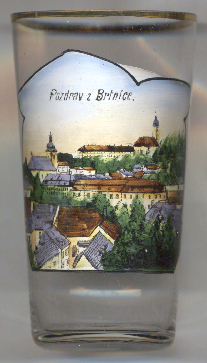
The  church of St. James the Greater [left, no. 0000: left] was built in the Baroque
style in 1727–1747 on the site of a previous, Gothic, church that had been demolished after a fire. The new church almost was destroyed
also by another fire in 1760, its restoration then dragged on until 1784.
church of St. James the Greater [left, no. 0000: left] was built in the Baroque
style in 1727–1747 on the site of a previous, Gothic, church that had been demolished after a fire. The new church almost was destroyed
also by another fire in 1760, its restoration then dragged on until 1784.
Brtnice monastery [top centre] was founded after the Collalto family took began the
re-catholicization of the estate, initially under the leadership of the Jesuit order. Construction began in 1629 and was led by the architect
Giovanni Battista Pieroni. In 1641 the Order of Minims (Paulan monks) took over; the convent itself was founded in 1644. In 1784, the monastery
was abolished following the reforms of Emperor Joseph II and the buildings were sold off. The monastery buildings served as the economic
background of the castle and later as a textile factory. Even later, the monastery was a warehouse and was also converted into residential
premises.
The church of St. Charles Borromeo and Blessed Giuliana di Collalto [top right]
was rebuilt before 1630 from the older Lutheran Church of St. Matthew. The original, Gothic, church of St. Matthew was built as a
family tomb for the Wallenstein at the end of the 16th century, and during the re-catholicization it was newly dedicated to the Assumption
of the Virgin Mary when the monastery was founded. It was rebuilt in the Baroque style by the Giovanni Battista Pieroni and incorporated into
the grounds of the newly built convent. After the monastery was abolished, it fell into disrepair and served as a warehouse, and was
deconsecrated in 1784. In 1831 it was restored and dedicated to the Blessed Giuliana di Collalto and St. Charles Borromeo.
[https://de.wikipedia.org/wiki/Brtnice;
https://cs.wikipedia.org/wiki/Kostel_svat%C3%A9ho_Jakuba_V%C4%9Bt%C5%A1%C3%ADho_(Brtnice);
https://cs.wikipedia.org/wiki/Kostel_blahoslaven%C3%A9_Juli%C3%A1ny_z_Collalta_(Brtnice);
https://cs.wikipedia.org/wiki/Kl%C3%A1%C5%A1ter_Brtnice]
![[scale]](lineal.jpg)