
|
|
| FRANCE | FRANCE |
| région: Centre-Val de Loire | |
| département: 45, Loiret |
map →

Orléans is situated at an elevation of 94 m in the northern bend of the river Loire where the river curves south towards the Massif central, about 112 km south-southwest of Paris. The city is the préfecture of the département Loiret and of the région Centre-Val de Loire. The city has a populatoin of about 116,400 (2023), the intercommunal structure Orléans Métropole has a population of 297,400 (2023). Orléans belongs to the vallée de la Loire sector between Sully-sur-Loire and Chalonnes-sur-Loire, which in 2000 was inscribed as a World Heritage Site by UNESCO (see list of other World Heritage sites of which there are glasses in this collection).
Cenabum, a Gaul stronghold, one of the principal towns of the tribe of the Carnutes where the Druids held their annual assembly, was destroyed by Julius Caesar in 52 BC. In the late 3rd century AD, Roman Emperor Aurelian rebuilt the city and renamed it civitas Aurelianorum ("city of Aurelians") after himself. The name later evolved into Orléans. In the Merovingian era, the city was capital of the Kingdom of Orléans following Clovis I's division of the kingdom, then under the Capetians it became the capital of a county then duchy held in appanage by the house of Valois-Orléans. The Valois-Orléans family later acceded to the throne of France via Louis XII, then François I. In 1108, Louis VI of France became one of the few French monarchs to be crowned outside of Reims when he was crowned in Orléans cathedral. The city was always a strategic point on the Loire, for it was sited at the river's most northerly point, and thus its closest point to Paris. There were few bridges over the dangerous river Loire, but Orléans had one of them, and so became — with Rouen and Paris — one of medieval France's three richest cities. On the south bank the "châtelet des Tourelles" protected access to the bridge. This was the site of the battle on 8 May 1429 which allowed Jeanne d'Arc to enter and lift the siege of the Plantagenets during the Hundred Years' War. Once the Hundred Years' War was over, the city recovered its former prosperity. The bridge brought in tolls and taxes, as did the merchants passing through the city. Later, during the Renaissance, the city benefited from its becoming fashionable for rich châtelains to travel along the Loire valley (a fashion begun by King Louis XI, whose royal domains included the nearby châteaus at Chambord, Amboise, Blois, and Chenonceau). The University of Orléans also contributed to the city's prestige. When France colonised America, the territory it conquered was immense, including the whole Mississippi River from its mouth to its source at the borders of Canada. Its capital was named La Nouvelle-Orléans (New Orleans) in honour of Philippe II, duke of Orléans, Louis XV's regent, and was settled with French inhabitants against the threat from British troops to the north-east. 1852 saw the creation of the Compagnies ferroviaires Paris-Orléans and its famous gare d'Orsay in Paris. In the Franco-Prussian War of 1870, the city again became strategically important thanks to its geographical position, and was occupied by the Prussians on 13 October that year. During World War II, the American Air Force heavily bombed the city, causing much damage. The city was one of the first to be rebuilt after the war.
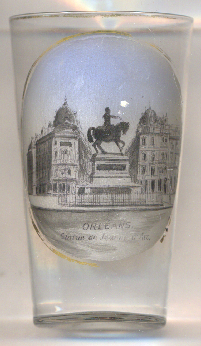
The  equestrian statue of Jeanne d'Arc [left, no. 4932], in Place du Martroi,
is a work by the sculptor Denis Foyatier, created in 1855. Majestic and imposing, it represents Joan of Arc, an emblematic
figure in French history, as a fearless war leader and a saint of the Catholic Church. The heroine is depicted with her sword
raised, mounted on her horse, embodying both the determination and courage that marked her destiny. Cast from the bronze of
nine cannons, the equestrian statue of Joan of Arc was unveiled with great pomp on 8 May 1855. A symbol of bravery and
determination, it was intended to replace the previous statue by Edme-François-Étienne Gois, which was considered too
modest and lacking the expected majesty to represent the national heroine. Indeed, the first work, while respectful of Joan of
Arc's iconography, no longer met the expectations of the 19th century, which desired a more imposing and triumphant image
of the Maid of Orléans. The older statue, created in 1804 by Gois, was moved in 1855 to the head of Pont George-V,
then in 1955 to the Quai du Fort-des-Tourelles, and since 2013 is located in Square de La Pucelle.
equestrian statue of Jeanne d'Arc [left, no. 4932], in Place du Martroi,
is a work by the sculptor Denis Foyatier, created in 1855. Majestic and imposing, it represents Joan of Arc, an emblematic
figure in French history, as a fearless war leader and a saint of the Catholic Church. The heroine is depicted with her sword
raised, mounted on her horse, embodying both the determination and courage that marked her destiny. Cast from the bronze of
nine cannons, the equestrian statue of Joan of Arc was unveiled with great pomp on 8 May 1855. A symbol of bravery and
determination, it was intended to replace the previous statue by Edme-François-Étienne Gois, which was considered too
modest and lacking the expected majesty to represent the national heroine. Indeed, the first work, while respectful of Joan of
Arc's iconography, no longer met the expectations of the 19th century, which desired a more imposing and triumphant image
of the Maid of Orléans. The older statue, created in 1804 by Gois, was moved in 1855 to the head of Pont George-V,
then in 1955 to the Quai du Fort-des-Tourelles, and since 2013 is located in Square de La Pucelle.
[https://www.fallingrain.com/world/FR/A3/Orleans.html;
https://en.wikipedia.org/wiki/Orl%C3%A9ans, https://de.wikipedia.org/wiki/Orl%C3%A9ans, https://de.wikipedia.org/wiki/Orl%C3%A9ans_M%C3%A9tropole;
https://fr.wikipedia.org/wiki/Statue_%C3%A9questre_de_Jeanne_d%27Arc_(place_du_Martroi,_Orl%C3%A9ans),
https://fr.wikipedia.org/wiki/Jeanne_d%27Arc_guerri%C3%A8re]
![[scale]](lineal.jpg)