
|
|
| ÖSTERREICH | AUSTRIA |
| Bundesland: Niederösterreich | Lower Austria |
| Bezirk: Hollabrunn |
map →

 The district town Hollabrunn is situated at an elevation of 236 m on the stream Göllersbach in the western Weinviertel region
of Lower Austria, about 46 km northwest ov Vienna and about 52 km northeast of Sankt
Pölten, the capital of Austria's state of Lower Austria. Hollabrunn is the administrative seat of the eponymous district; the
municipality has a population of about 12,600 (2026).
The district town Hollabrunn is situated at an elevation of 236 m on the stream Göllersbach in the western Weinviertel region
of Lower Austria, about 46 km northwest ov Vienna and about 52 km northeast of Sankt
Pölten, the capital of Austria's state of Lower Austria. Hollabrunn is the administrative seat of the eponymous district; the
municipality has a population of about 12,600 (2026).
 The first mentioning in a document (Holerbrunen) dates from 1135. Hollabrunn superior or Oberhollabrunn was the official
name from 1288 until 1928, when it was changed to Hollabrunn. The rights of a market town were obtained prior to 1377.
Most parts of the town were destroyed during the Napoleonic Wars of 1805 and 1809 (the 'Battle of Hollabrunn and Schöngrabern' is mentioned in an inscription
on the Arc de Triomphe in Paris and in Leo Tolstoj's book 'War and Peace').
(Ober)Hollabrunn received the status of a town in 1908.
The first mentioning in a document (Holerbrunen) dates from 1135. Hollabrunn superior or Oberhollabrunn was the official
name from 1288 until 1928, when it was changed to Hollabrunn. The rights of a market town were obtained prior to 1377.
Most parts of the town were destroyed during the Napoleonic Wars of 1805 and 1809 (the 'Battle of Hollabrunn and Schöngrabern' is mentioned in an inscription
on the Arc de Triomphe in Paris and in Leo Tolstoj's book 'War and Peace').
(Ober)Hollabrunn received the status of a town in 1908.
The  parish church Sankt Ulrich [near left, no. 4245: background, and below left and right,
nos. 5000 and 645: background centre centre] goes back to a Romanesque church of the 12th century. The parish was founded
around 1220. The Early Gothic chancel and crypt date from the 14h century. The interior was remodelled in the Baroque style during the
17th century, and remodelled in Neo-Gothic style during the late 19th century.
parish church Sankt Ulrich [near left, no. 4245: background, and below left and right,
nos. 5000 and 645: background centre centre] goes back to a Romanesque church of the 12th century. The parish was founded
around 1220. The Early Gothic chancel and crypt date from the 14h century. The interior was remodelled in the Baroque style during the
17th century, and remodelled in Neo-Gothic style during the late 19th century.
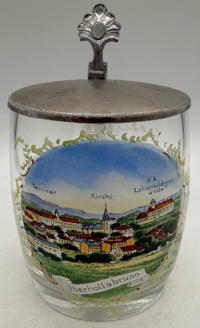
The Hollabrunn Boys' Seminary [left, no. 5000, and below, no.ᤷ: background left],
later the Hollabrunn Archbishop's Seminary was built in 1880 by the architect Richard Jordan. The archdioceses's seminary for boys had
already been founded in Vienna in 1856 and was relocated to Hollabrunn in 1881. After the annexation of Austria by the Third Reich, the seminary
was dissolved in 1938, but re-opened in in 1945/46 after the end of World War II, while still under Soviet occupation. A private
Secondary Preparatory School was founded in 1974/75, sponsored by the archdiocese of Vienna. The school is sponsored by the Archdiocese of
Vienna. The preparatory secondary school is a private school with public accreditation. The preparatory secondary school model was intended to
allow 14-year-olds after completing lower secondary school and those with a late vocation to the priesthood to enter the Hollabrunn seminary.
From the beginning, the school was also open to external students and girls. The classrooms are located in the Hollabrunn seminary building.
In 1995, a former student leveled serious allegations against the former head of the preparatory school, later Cardinal Hans Hermann Groër, archishop of Vienna, regarding past sexual abuse. Subsequently, also other former students came forward and reported similar harassment or abuse. Groër remained silent but resigned as chairman of the Bishops' Conference, later also as bishop. Groër did never comment definitively on the accusations until his death in 2003.

The former k.k. Lehrerbildungsanstalt (Imperial Royal teacher training institute) [above left,
no. 5000, and near left, no.ᤷ: background right] was built in 1908 to commemorate Oberhollabrunn's elevation to city status.
In December 1964, almost exactly 100 years after the founding of the Gymnasium am Kirchenplatz (High School at Church Square), the school
moved to its current building at Reucklstraße 9. The modern Federal Grammar School and Federal Secondary School, as its name
suggests, now consists of two separate branches with different focuses: In the academic track, from grades 1 to 8, the emphasis is
on a broad general education with in-depth study of the modern foreign languages English, French, and Spanish as electives. In the secondary
school, the natural sciences and the use of computers form an additional focus.
[https://de.wikipedia.org/wiki/Hollabrunn;
https://de.wikipedia.org/wiki/Pfarrkirche_Hollabrunn;
https://de.wikipedia.org/wiki/Knabenseminar_Hollabrunn;
http://alt.bghollabrunn.ac.at/?seite=geschichte]
![[scale]](lineal.jpg)